therapy frameworks
Stop People-Pleasing.
Start Setting Boundaries.
Know what you actually want, and have the words to say it.


You learned to say yes to stay safe. It's a nervous system pattern, and it can be unlearned.
adults identify as people-pleasers
YouGov, 2024
to interrupt an automatic yes
underestimate how hard saying no really is
Bohns, 2016, Cornell
How it works
Ninety seconds of clarity
Step 1
Breathe
A guided pause. Space before your brain can think.
Step 2
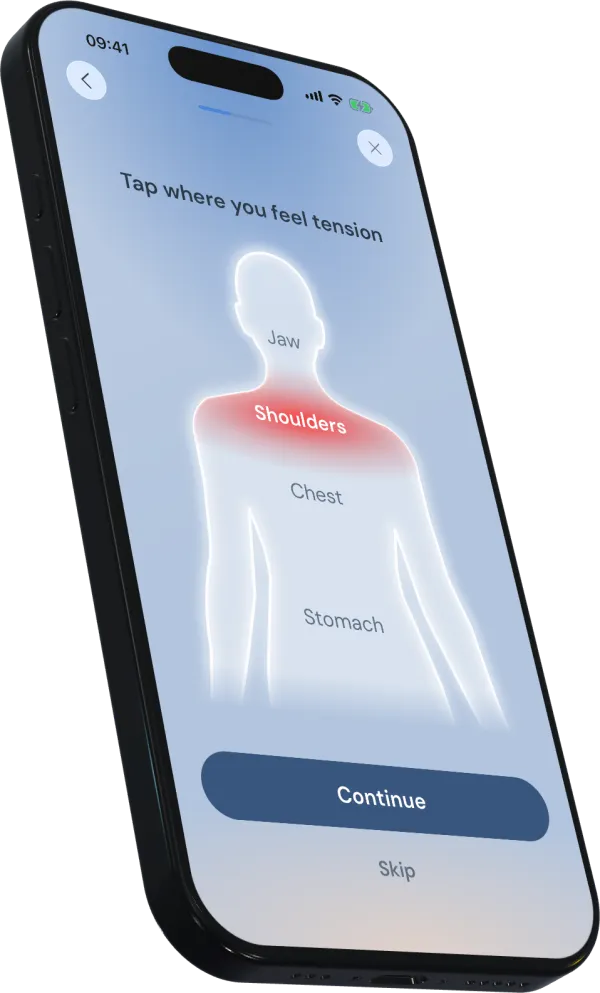
Feel where it lives
Your body knows what you want before your brain does.
Step 3
Get the words
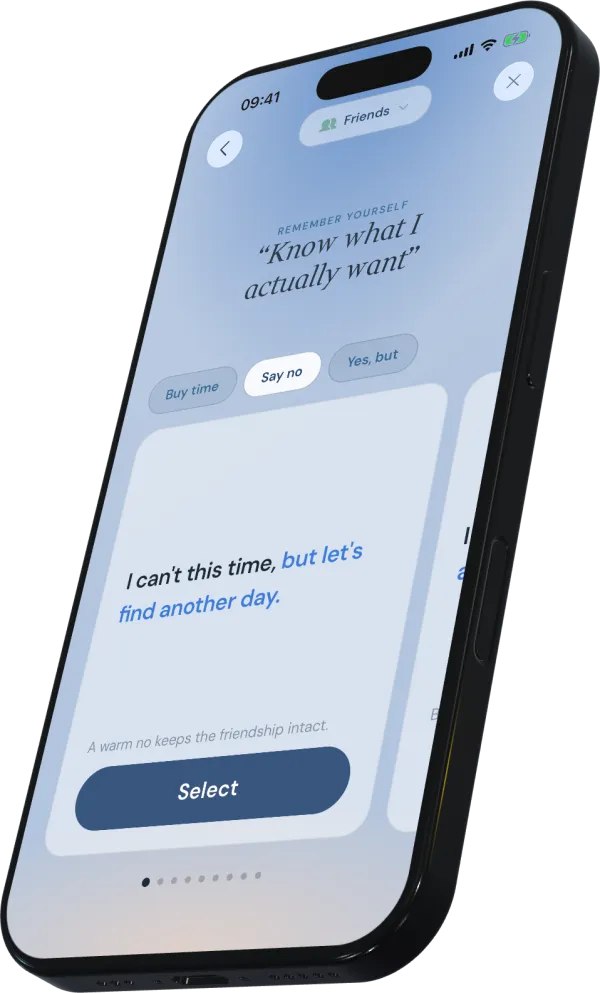
Scripts for your exact situation. Words you can actually say.
Step 4
Decide
Yes or no, both celebrated equally.
What you actually get
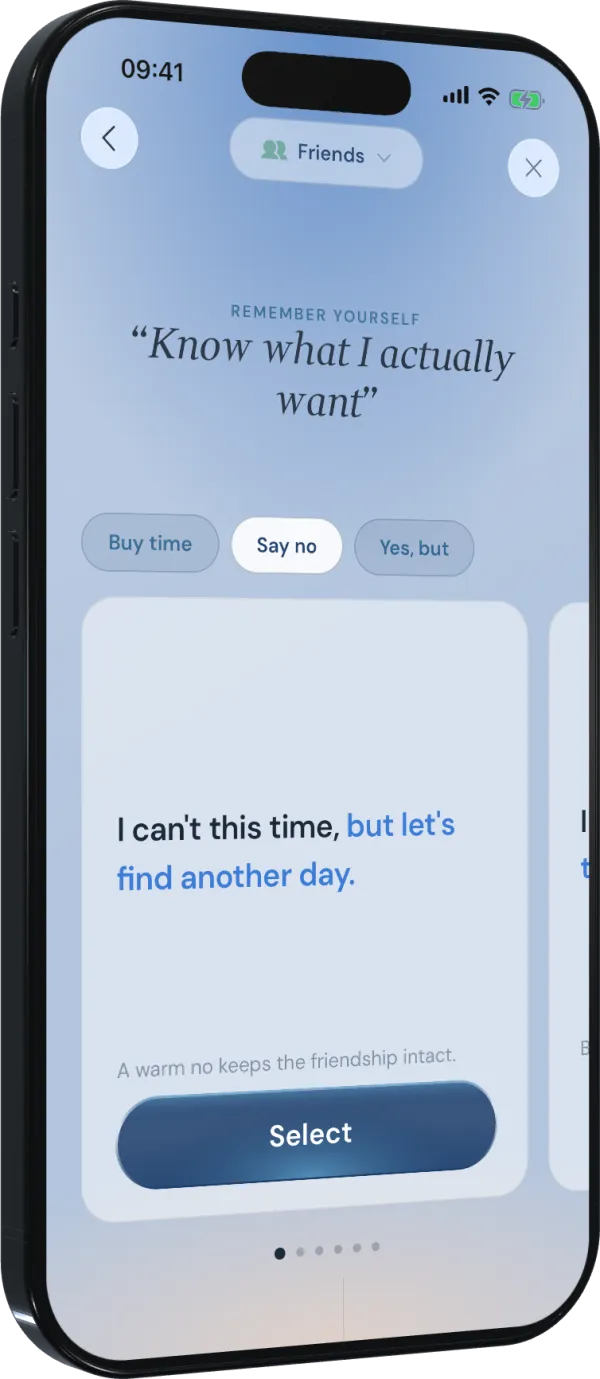
Know what to say
Words ready when you need them
Real scripts for work, family, friends, and dating. Choose how to say no, buy time, or set a condition. Personalized to your situation and your people-pleasing pattern.
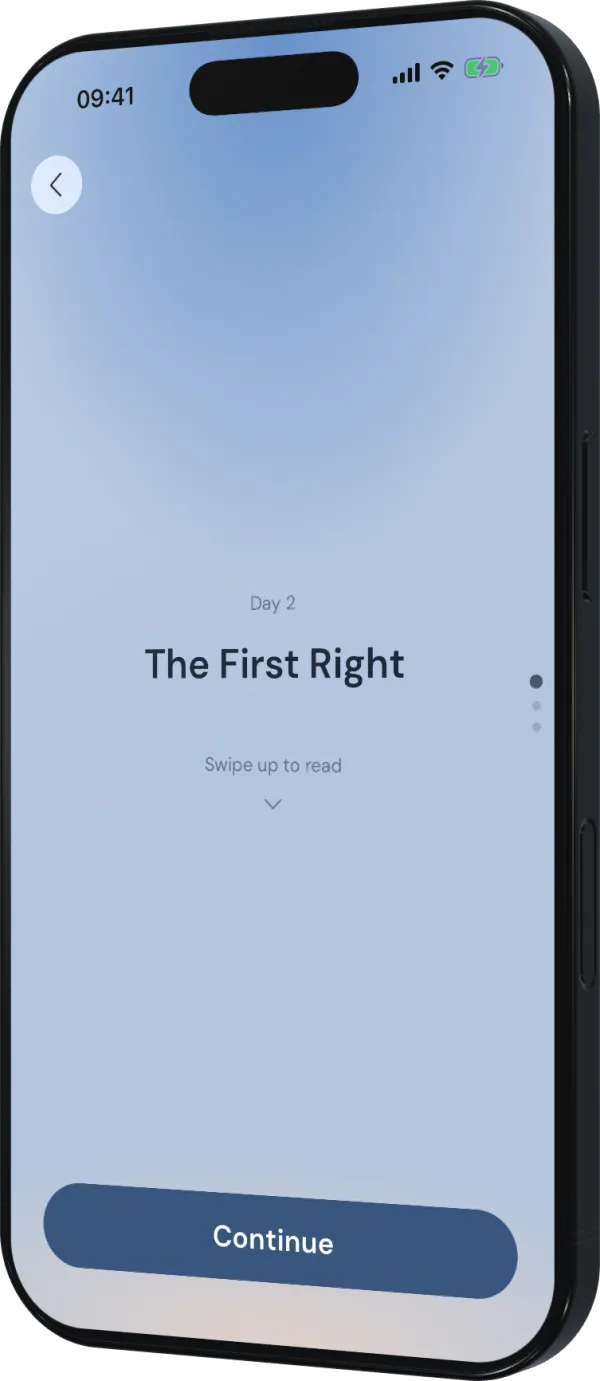
A reading for today
Understand the automatic yes
Short daily readings explore guilt, fear, and the urge to keep everyone happy. Read today's piece or return to earlier readings from your profile.
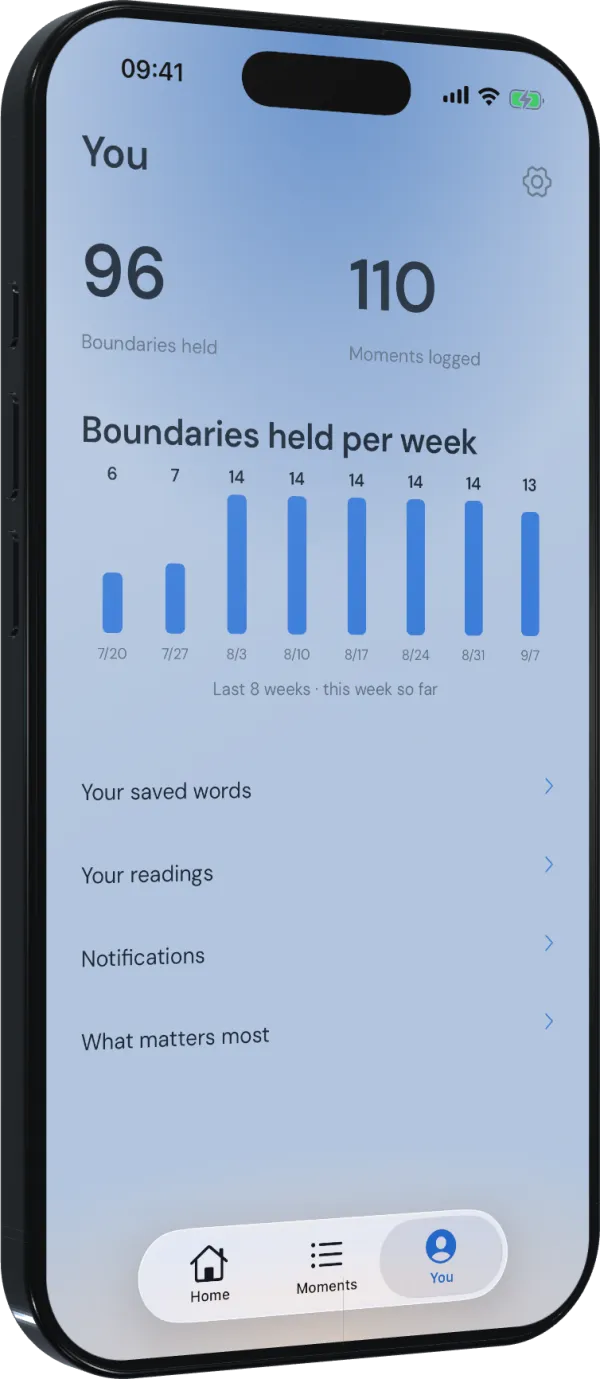
Your own record
Keep track of what actually happened
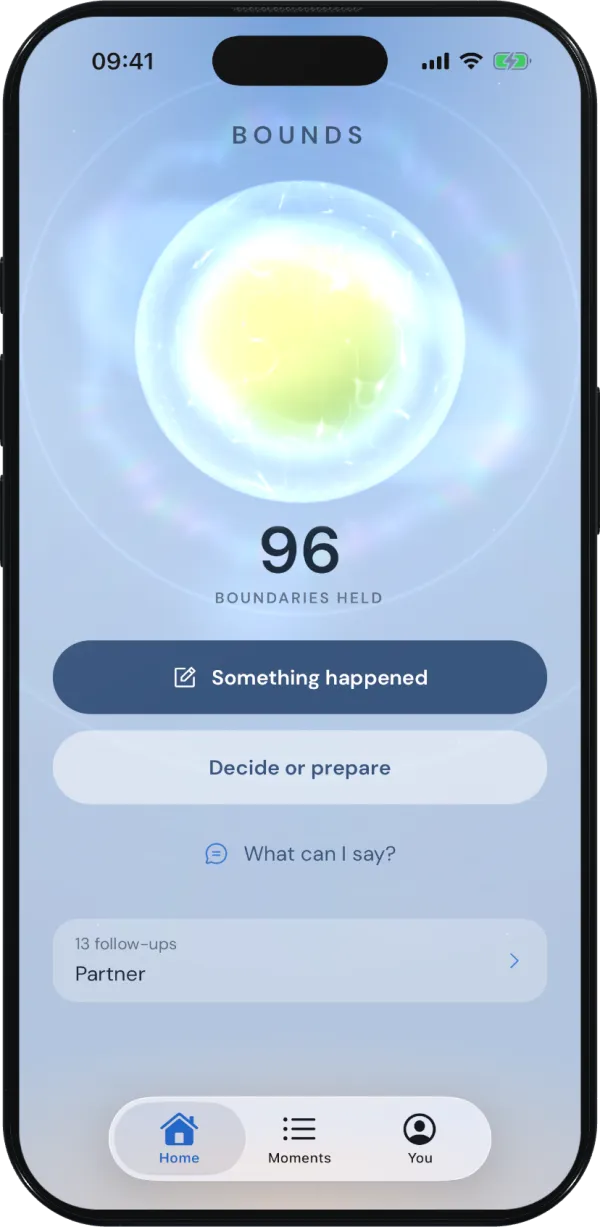
See the moments you logged and the boundaries you reported holding. Answer what happened afterwards. Your record uses your answers, including the difficult ones.
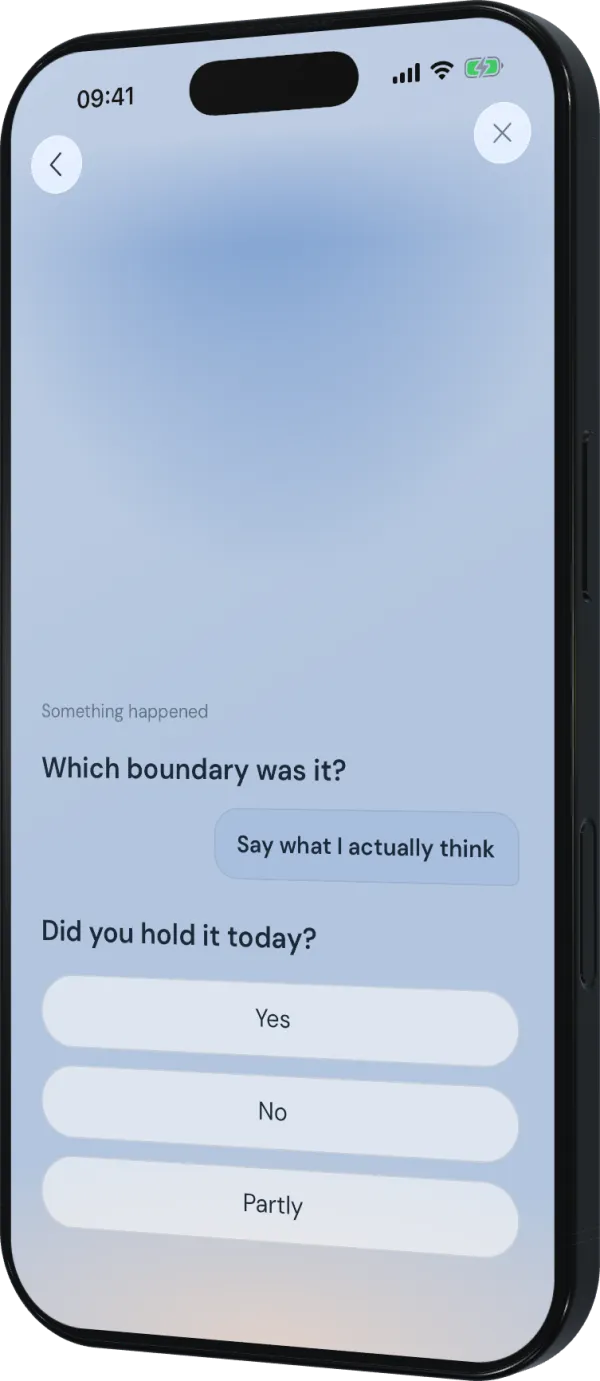
After the conversation
Still replaying it?
Record whether your boundary held and what got in the way. Work through the thought, prepare words for next time, or choose when to return to it.
The research
What the science
actually says
This isn't a personality flaw. It's a survival pattern.
People-pleasing is a trauma adaptation, your nervous system learned that keeping others happy kept you safe. It made sense then. It can be unlearned now.
Pete Walker
Complex PTSD: From Surviving to Thriving
Your brain physically changes when you choose differently.
Every time you pause instead of reacting, you're building a new neural pathway. The old autopilot weakens. The new one gets stronger.
Dr. Jeffrey Schwartz
Neuroplasticity research, UCLA
The opposite of people-pleasing isn't selfishness.
It's authenticity. The fear that setting boundaries makes you a bad person, that's the pattern talking. The people worth keeping don't leave when you're honest.
Dr. Aziz Gazipura
Not Nice
The science
Five therapy frameworks
Built on research into why you people-please, and how to stop. Every feature is backed by a proven therapy modality.
IFS
The parts of you that say yes to protect you.
Polyvagal
Helping your nervous system feel safe enough to choose.
Somatic
Your body knows the answer before your brain does.
CBT & ACT
Act on your values, not your fear.
FAQ
Frequently asked
questions
People-pleasing is a pattern where you automatically prioritize others' needs over your own, often without realizing it. It's not kindness. It's a nervous system response your body learned to stay safe. Bounds helps you recognize the pattern and interrupt it before you say yes when you mean no.
No. Bounds is a "know what you actually want" app. A genuine yes is celebrated equally to a no. The goal isn't to refuse everything, it's to make decisions that are truly yours, not automatic reactions driven by guilt or fear.
Bounds is built on five evidence-based frameworks: Internal Family Systems (IFS), Polyvagal Theory, Somatic Experiencing, Cognitive Behavioral Therapy (CBT), and Acceptance & Commitment Therapy (ACT). These inform everything from the breathing exercises to the personalized scripts.
Therapy apps give you exercises to do later. Bounds gives you a 90-second guided pause in the exact moment you need it, when someone asks you for something and your body is already saying yes. It's a real-time intervention tool, not a course.
When you open a decision, Bounds guides you through a quick body scan, jaw, shoulders, chest, stomach. Research shows these areas hold tension when you're about to override your own needs. Noticing where the tension lives helps you access what you actually want before your automatic response takes over.
Based on your people-pleaser type and the specific situation (work, family, friends, dating, money), Bounds gives you real words to say. Not therapy speak, actual sentences you can use. "I need to think about it" is more powerful than most people realize.
Yes. Your decisions, scripts, and personal reflections stay on your device, Bounds is local-first. We collect anonymous usage analytics (like which features are used) to improve the app, but your boundary content is never uploaded. Your journal is yours alone.
Bounds offers annual and monthly subscriptions. Eligible annual subscribers can start with a 7-day free trial. Your store shows the local price and renewal terms before purchase. Both plans include decision support, saved words, your personal record, and daily readings.
Eligible annual subscribers can try Bounds free for 7 days. Trial availability and the charge after the trial are shown before purchase. Monthly subscriptions do not include a free trial.
Yes. People-pleasing and codependency share the same root, difficulty distinguishing your needs from others'. Bounds helps you build that distinction one decision at a time. Many users find that consistent boundary-setting with Bounds naturally addresses codependent patterns.
Most users report a shift within the first two weeks, not in saying no more often, but in noticing the moment before the automatic yes. That awareness is the breakthrough. The guilt after setting a boundary typically decreases significantly by week four.
If you're in a relationship with a narcissistic person - partner, parent, boss - you've likely developed people-pleasing as a survival strategy. Bounds helps you recognize when you're overriding your own needs to manage their reactions, and gives you scripts to hold boundaries even when the other person pushes back. It won't fix them, but it can help you stop losing yourself.
Overthinking and people-pleasing are deeply connected. You replay conversations, anticipate reactions, search for the 'perfect' response that won't upset anyone. Bounds interrupts that loop with a 90-second body-based pause - getting you out of your head and into what you actually feel. Many users say this is where the overthinking finally quiets down.
If you absorb other people's emotions and struggle to separate their needs from yours, yes. Empaths often develop people-pleasing patterns because they feel others' discomfort so intensely that saying no feels physically painful. The somatic body check in Bounds helps you distinguish between their feelings and yours - so you can care deeply and still have boundaries.
It's okay
to have needs
Start with one decision. See what changes.